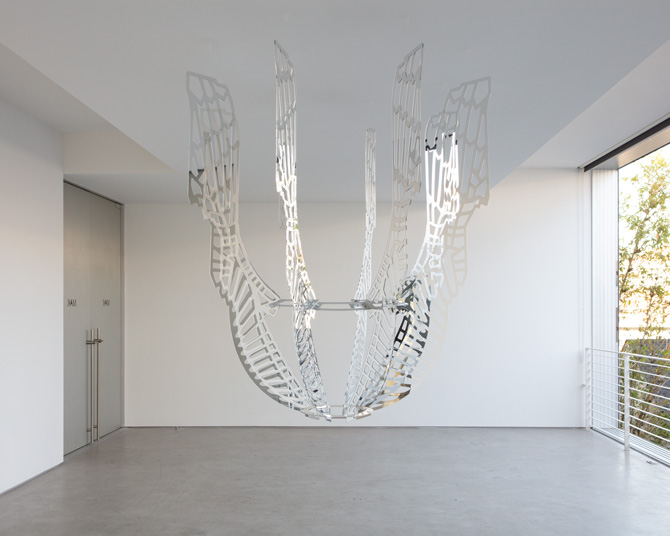
Inverted Dome is an inquiry into the dynamics of light, technology, and perception generated by public architecture.
The exhibition’s central feature is an installation that reimagines the U.S. Capitol Dome as an inverted, open, and almost unrecognizable structure made of mirror, reflecting back both the environment and itself. Images of the Capitol Dome are continuously propagated by media organizations of all kinds—reproduced on web pages, news broadcasts, and social feeds—as if the building’s image has come to represent structures of power that are otherwise too abstract to locate. The room-sized installation is a container for holding and focusing light and its refractions, becoming a site for reflection on virtual mediation and transparency.
Inverted Dome references historical works of California Light and Space; augmented realities; architectures of the metaverse; considerations of public and private space; presence and absence; Monument to the Third International by Vladimir Tatlin; cryptography; information theory; and the mediation of power in daily life.
The exhibition includes an installation, a sequence of digital studies released online throughout the duration of the show, and a publication, which together suggest new spatial and experiential possibilities for public architecture.
The catalog essay Form and Content by Michael Ned Holte is available for download here.
The catalog essay Socle, Scale, Sequence concerning Inverted Dome and Digital Study #1 (Mirror Chain) by Chris Fite-Wassilak is available for download here.
And the limited-edition catalog that accompanies the exhibition is available for purchase here.
Kristin Posehn: Inverted Dome is organized by Aurora Tang. The exhibition is made possible with support from the Pasadena Art Alliance and the MAK Center Patron Program.


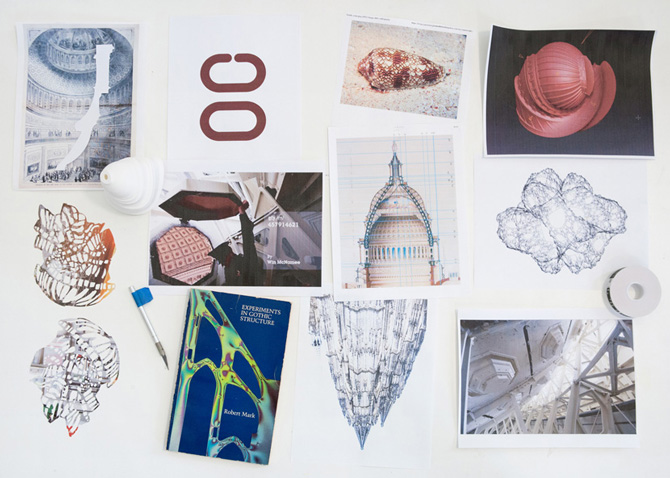
In conjunction with the exhibition Kristin Posehn: Inverted Dome at the MAK Center for Art and Architecture, the following series of fully digital studies were released online via the MAK Center email list, social media accounts, and website.
The catalog essay Socle, Scale, Sequence by Chris Fite-Wassilak concerning Digital Study #1 (Mirror Chain) and Inverted Dome can be downloaded here. The limited-edition catalog that accompanied the exhibition is available for purchase here.
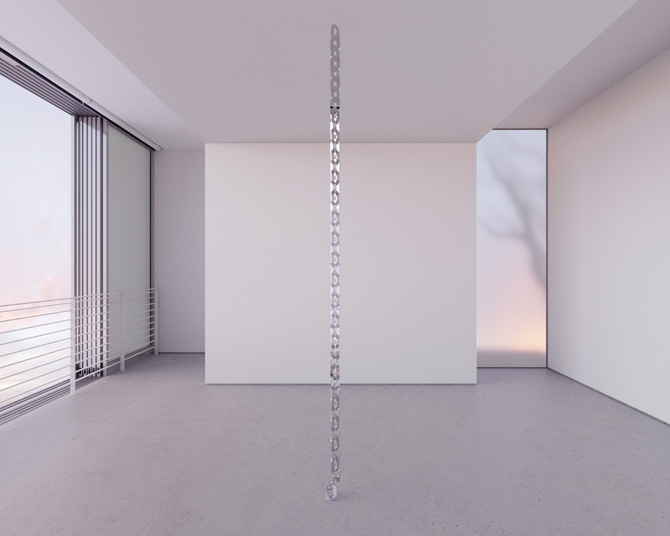
Digital Study #1 (Mirror Chain)
Release date: February 10, 2022
Replacing the inverted U.S. Capitol Dome installed within the physical gallery, in this virtual world we find a length of mirrored chain that stretches from floor to ceiling.
Mirror Chain references both the concept of a blockchain first advanced by Satoshi Nakamoto in Bitcoin: A Peer-to-Peer Electronic Cash System, and the proliferation of cryptocurrencies that have followed in its wake. One is also invited to consider the phenomena of supply chains, chains that bind, and chains that are worn in popular culture to signal wealth and status.
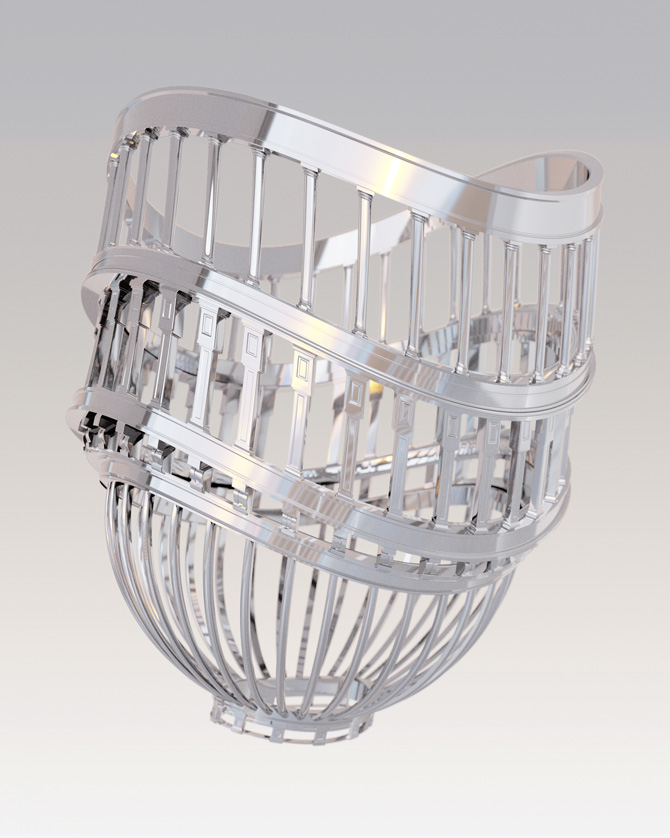
Digital Study #2 (Azimuth Wave)
Release date: February 17, 2022
Azimuth is a type of angular measurement. It establishes an orientation in relation to a point of interest within a spherical coordinate system. The concept is typically used in navigation, mapping, astronomy, and other disciplines.
In everyday speech, a mirror is a surface that reflects back an inverted image of its surrounding environment. Mirrors in our homes are used for self-reflection, in our cars for navigation, and throughout cities as exterior cladding for skyscrapers. More broadly, a mirror is a wave reflector—optical mirrors reflect light waves, but other types of mirrors reflect audio or even atomic waves.
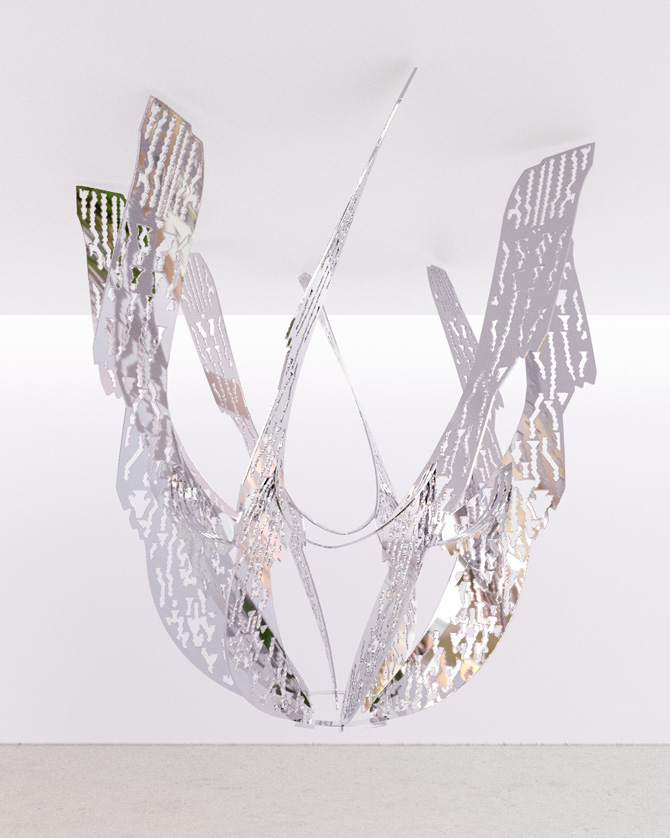
Digital Study #3 (Training Phantom)
Release date: February 24, 2022
Excerpt from an interview with exhibition curator Aurora Tang:
TANG: How do you see these digital studies in relation to the physical exhibition?
POSEHN: It's been a back-and-forth evolution. As I was fabricating the sculpture, installing, and then documenting it, I was also 3D modelling the gallery. It was fascinating to be in the gallery and observe how light falls in the space at different times of day, and then go to my studio and juxtapose that with how light was being rendered in the 3D environment I was building. The conversations we've had in the gallery and responses from visitors have brought up new ideas that are filtering into the studies. It's been a way for the work to continue to unfold, respond, and reflect in real time.
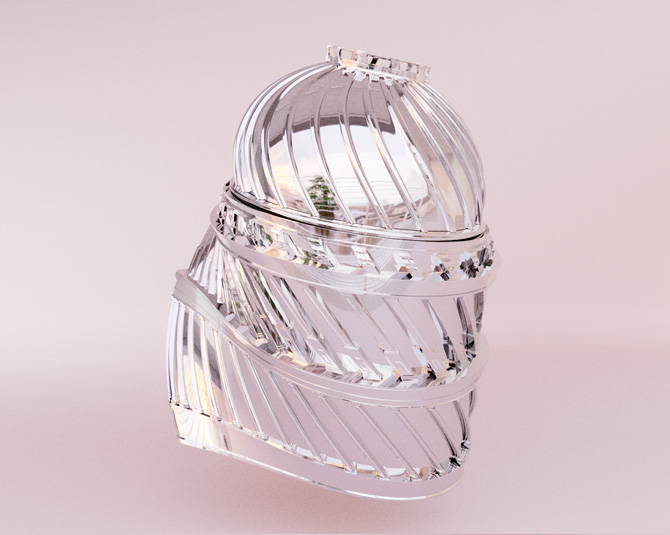
Digital Study #4 (Chimera)
Release date: March 3, 2022
A chimera is an organism composed of multiple tissues with different genetic composition. In Greek mythology, a chimera is a hybrid being—part lion, goat, and snake. As an animation, Digital Study #4 (Chimera) morphs between three states in an infinite loop, reflecting an otherwise unseen backdrop all the while.
The series of digital works, catalog essays, documentation of the installation, and more is included in the Inverted Dome publication.
- Made possible with the support of the Pasadena Art Alliance and the MAK Center Patron Program
- With additional thanks to Aurora Tang, Jia Yi Gu, Allie Smith, Tristan Espinoza, Ann Basu, Priscilla Fraser, Salome Schmuki, and Charlene Matthews